LoRaWAN Technology
Low Power Wide Area Network (LPWAN) — secure and scalable IoT connectivity for smart agriculture, cities, asset tracking and buildings.
What is LoRaWAN?
LoRaWAN (Long Range Wide Area Network) is a low-power, wide-area networking protocol designed for wireless battery-operated IoT devices. It enables long-range communication between end-devices and gateways, which forward data to a network server and ultimately to application servers — all secured with AES-128 encryption and optimized for minimal energy consumption.
LoRaWAN Architecture
From end-device sensors to application servers — data flows securely across the entire LoRaWAN stack.
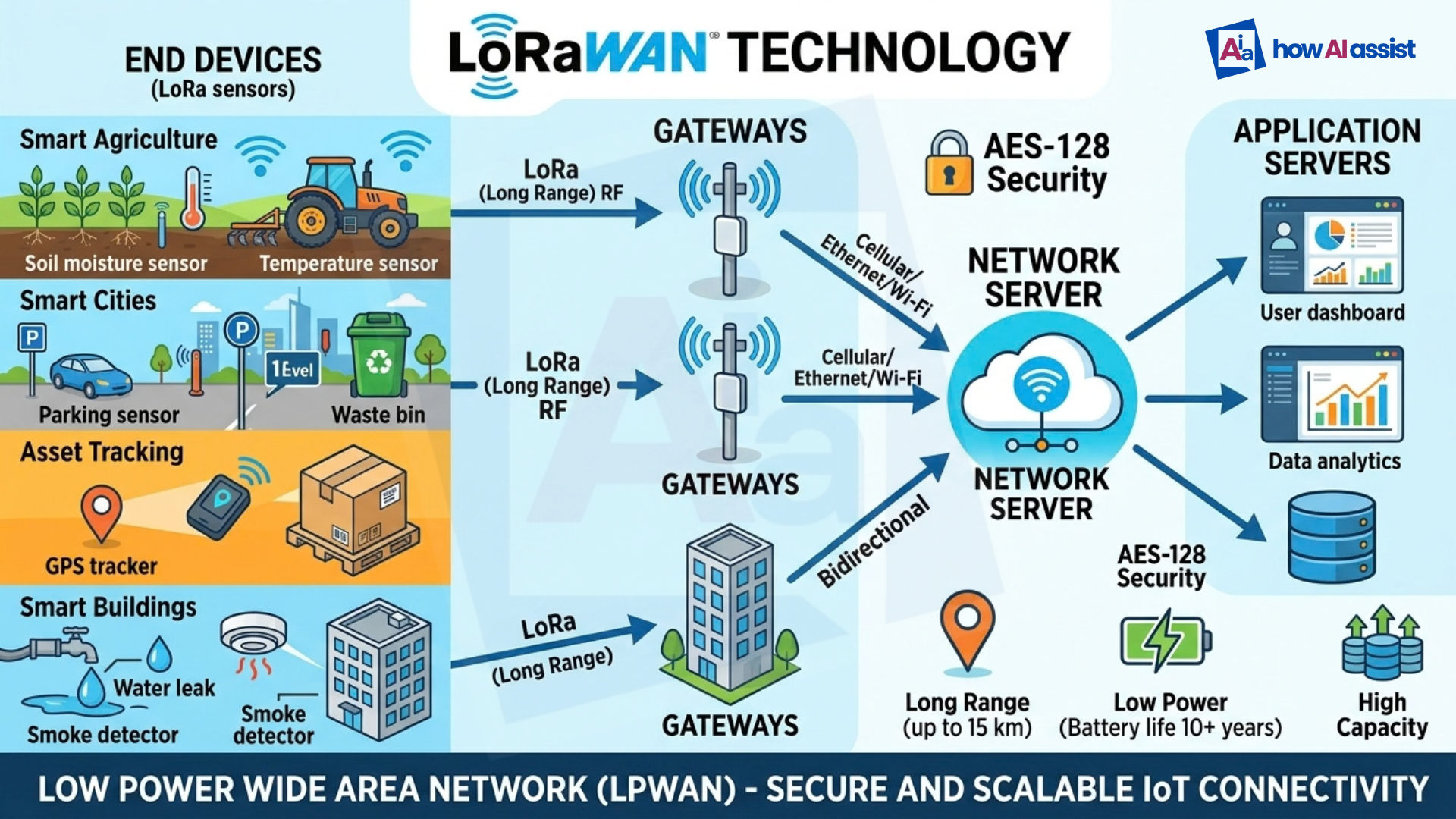
End Devices
LoRa sensors across sectors
Gateways
Receive via LoRa RF
Network Server
Cellular / Ethernet / Wi-Fi
Application Servers
Dashboards & analytics
15 km
Max Range (Rural)
10+ yrs
Battery Life
50K+
Devices per Gateway
AES-128
Encryption
Key Advantages
Seven core benefits that make LoRaWAN the leading LPWAN protocol for IoT deployments worldwide.
Ultra-Long Range Coverage
- Signals transmit up to 10–15 km in rural/open areas and 2–5 km in dense urban environments.
- High signal penetration reaches deep indoors, underground basements, and soil-level sensors.
Extreme Low Power Consumption
- Sensors stay in deep sleep mode, waking only briefly to transmit small data packets.
- End-devices run on a standard battery for 5 to 10+ years without replacement or maintenance.
Cost-Effective Deployment
- Unlicensed Spectrum: Operates on free ISM radio bands (868 MHz in Europe, 915 MHz in the US) with no ongoing license fees.
- Reduced Infrastructure: Wide coverage radius means fewer gateways cover large areas vs. Wi-Fi or cellular.
High Scalability & Capacity
- A single gateway handles tens of thousands of devices and processes millions of messages.
- Network capacity scales easily by adding gateways as device density grows.
Strong End-to-End Security
- Dual-layer AES-128 encryption (Network Session Key + Application Session Key).
- Ensures data confidentiality and guards against eavesdropping or unauthorized access.
Flexible Deployment Options
- Supports public networks (telecom operators) and private networks (businesses, smart cities).
- Private deployments give full data ownership and control.
Native Geolocation Without GPS
- Estimates device location using triangulation (TDoA — Time Difference of Arrival).
- No energy-intensive GPS chips needed — saves power and cost on tracker devices.
Ultra-Long Range Coverage
- Signals transmit up to 10–15 km in rural/open areas and 2–5 km in dense urban environments.
- High signal penetration reaches deep indoors, underground basements, and soil-level sensors.
Extreme Low Power Consumption
- Sensors stay in deep sleep mode, waking only briefly to transmit small data packets.
- End-devices run on a standard battery for 5 to 10+ years without replacement or maintenance.
Cost-Effective Deployment
- Unlicensed Spectrum: Operates on free ISM radio bands (868 MHz in Europe, 915 MHz in the US) with no ongoing license fees.
- Reduced Infrastructure: Wide coverage radius means fewer gateways cover large areas vs. Wi-Fi or cellular.
High Scalability & Capacity
- A single gateway handles tens of thousands of devices and processes millions of messages.
- Network capacity scales easily by adding gateways as device density grows.
Strong End-to-End Security
- Dual-layer AES-128 encryption (Network Session Key + Application Session Key).
- Ensures data confidentiality and guards against eavesdropping or unauthorized access.
Flexible Deployment Options
- Supports public networks (telecom operators) and private networks (businesses, smart cities).
- Private deployments give full data ownership and control.
Native Geolocation Without GPS
- Estimates device location using triangulation (TDoA — Time Difference of Arrival).
- No energy-intensive GPS chips needed — saves power and cost on tracker devices.
LoRaWAN vs. Bluetooth vs. Wi-Fi
A side-by-side comparison across the metrics that matter most for IoT deployments — and why LoRaWAN is the clear winner for large-scale, low-power sensor networks.
| Feature | LoRaWAN | Bluetooth | Wi-Fi |
|---|---|---|---|
| Range | Up to 15 km (rural) / 2–5 km (urban) | ~10–100 m | ~30–100 m |
| Indoor Penetration | Excellent — passes through concrete & stone | Poor — blocked by walls | Moderate — limited by walls |
| Battery Life | 5–10+ years on a single battery | Days to weeks | Hours to days |
| Power Consumption | Ultra-low (ideal for IoT) | Low–moderate | High |
| Devices per Gateway | Tens of thousands | 7 (classic) / ~20 (BLE mesh) | ~30–250 (bandwidth-limited) |
| Data Rate | 0.3–50 kbps (small packets) | 1–3 Mbps | Up to multi-Gbps |
| Spectrum Cost | Free — unlicensed ISM bands | Free — unlicensed | Free — unlicensed |
| Infrastructure Cost | Low — few gateways cover large areas | Low per device | High — many APs needed |
| Security | AES-128 end-to-end (dual-layer) | AES-128 (varies by version) | WPA2/WPA3 |
| Best Suited For | Large-scale IoT sensor networks | Short-range personal devices | High-bandwidth internet access |
The Verdict: LoRaWAN Wins for IoT
While Bluetooth and Wi-Fi excel at short-range, high-bandwidth personal connectivity, neither was designed for large-scale IoT. LoRaWAN uniquely combines multi-kilometre range, multi-year battery life, and support for tens of thousands of devices per gateway — making it the clear best choice for smart agriculture, cities, asset tracking, and building automation deployments.
How Many Devices Can a LoRa Gateway Support?
A single LoRaWAN gateway can support a wide range of connected devices depending on how frequently each device transmits and the payload size. The table below illustrates typical capacity across low, moderate, and high traffic scenarios.
Low Traffic Applications
Tier 1
Moderate Traffic Applications
Tier 2
High Traffic Applications
Tier 3
| Parameter / Aspect | Low Traffic Applications | Moderate Traffic Applications | High Traffic Applications |
|---|---|---|---|
| Transmission Frequency | 1 – 2 times per day | Every 10 – 15 minutes | Every 30 – 60 seconds |
| Typical Payload Size | 10 – 20 Bytes | 20 – 50 Bytes | 50 – 100 Bytes |
| Airtime per Uplink (SF7) | ~30 – 50 ms | ~50 – 100 ms | ~100 – 300 ms |
| Single 8-Channel Gateway Capacity | 10,000 – 50,000+ devices | 1,000 – 5,000 devices | 100 – 500 devices |
| Single 16-Channel Gateway Capacity | 20,000 – 100,000+ devices | 2,000 – 10,000 devices | 200 – 1,000 devices |
| Example Use Cases | Smart water/gas meters, smoke detectors | Smart agriculture, environmental sensing | Fleet tracking, real-time industrial alarms |
Capacity figures are indicative and depend on regional duty-cycle regulations, spreading factor distribution, and application-level retransmission behaviour.
Ready to Deploy LoRaWAN?
Talk to our team about building secure, scalable IoT solutions with LoRaWAN technology.
Get in Touch